Home › Forums › Discussion › Week 9: Discussion A
Tagged: Discussion, Week 9
This topic contains 16 replies, has 9 voices, and was last updated by 
-
AuthorPosts
-
March 27, 2016 at 1:12 pm #690
Our intensity levels in the BLoS development start with the Submaximal Effort Method. Zatsiorsky states, the Maximal Effort Method has limitations to beginners because of high risk of injury from lack of technique and lack of neuromuscular coordination (1995, p.81). Our use of the Submaximal Effort Method allows the athlete to develop the needed neuromuscular coordination and technical proficiency that will be needed once the weight gets heavy and the athlete begins to reach his rep max. The volume of our BLoS program is steady throughout each weak until the athlete begins to fail. When the athlete fails, volume self-adjusts based on the volume. Remember when Luke said “load must dictate reps”? This is what we are talking about for this program; the intensity (load) must dictate volume (reps) to drive the specific adaptation we are training for (The Amateur Program, 2016, Time hack 10:48).
I mentioned when an athlete fails earlier, now we will talk about the failure and reset. The program will self-regulate when failure occurs. We’ll see the athlete start to fail in the 1-3 rep range down the road in the program. This allows the athlete to get the majority of adaptation through the CNS rep range and well back off the weight to 3 weeks back. Intensity drops and volumes rises. This allows use to work on the athletes general speed and continue to get more and more reps under the bar to train towards the athlete’s unconscious-competence (automatic motor response) (Siff, 2004, p.24).
The volume and intensity in the BLoS program works like the ebb and flow of the tide in the ocean. At the beginning we have a constant flow inward (intensity increasing). The flow cannot go forever and will start to ebb back. This is indicative of our reset. We push the intensity until we can’t go any more and well reset (ebb) the athlete and they will flow back up the shore even more past the last weight they successfully completed. This is the proof of further adaptation for the athlete. This ebb and flow is the art and science the coach needs to manage through the program to accelerate the adaptation of establishing the BLoS.
-
March 27, 2016 at 1:28 pm #692
@benkuch great job tying in the Submaximal Effort Method with the amateur program. It was right there staring my in the face if it were a snake it would have bit me, but then I would have had to have @mcquilkin suck the poison out of my ass cheek!
-
March 27, 2016 at 8:25 pm #705
Does intensity have to be dictated as the load? Can you increase intensity when the load decreases by increasing the speed of the lift?
-
March 28, 2016 at 5:46 am #708
I think you’re right DD, but we are always sending the bar into orbit. So the intensity of lifting 135 slow vs lifting it as fast as fucking possible definitely changes the intensity and we Know from DR. Squat that by using compensatory acceleration training we are increasing the work of the muscle by recruiting and firing more motor units during the lift. Im not sure its the same as adding weight, although the muscle may disagree..? I suppose it is. Greater contractile response from the muscle = greater intensity.
-
March 28, 2016 at 6:20 am #710
@train608 to play devil’s advocate that we are “always thinking about sending the bar to orbit”, I don’t know if that is true. In the amateur program we don’t talk about introducing general speed of the lift and taking advantage of CAT until the reset occurs. So I think @menacedolan makes a good point here.
-
March 28, 2016 at 8:37 am #716
@menacedolan @train608 @chobbs
I don’t think that using compensatory acceleration changes the intensity of the lift. If that were the case, then lifting the weight slowly would decrease the intensity of the lift and you would be able to avoid taxing the CNS with heavier loads simply by moving like molasses on a cold morning in winter.
I do agree that the volume of lifts completed at a higher intensity continues to increase as the BLOS is established. An athlete that starts a 3 x 5 linear progression with a squat weight that may be 70% of a theoretical maximum effort will likely be completing 3 x 5 with a squat weight in excess of 90% after 12 or so weeks. So even though the total rep count of 15 has remained constant, because the load is significantly greater the intensity of each rep has increased and the volume of those same 15 reps is much greater stimulus.
In the 2004 edition, Siff writes “there is a linear increase in absolute strength in response to a given regime of loading, which slows down as the limit of this optimal time-span of training is reached…” (p. 357) and he continues with regard to special training for explosive strength:
“When explosive strength is the purpose of special training, there is a clear tendency for the rise in explosive strength to slow down; the sharper its growth, the earlier it plateaus. When one is emphasizing the development of explosive strength exclusively, the plateau appears within 3-4 months. In those cases, where explosive strength is not the key ability, the increase in explosive strength can continue for up to 10 months.” (p. 357)
This progress increase in both intensity and volume of work at higher intensity is supported by the work of sprint coach Charlie Francis who writes: “The benefit of maintaining all high intensity elements at all times should be obvious: firstly, it guarantees that strength or speed or power accrued will not be lost due to a prolonged downtime; and secondly, it allows for a longer period for improvement at each element.” (p. 16)
While excessive intensity and volume will tax the body beyond its ability to adapt, gradual increases in both will allow an athlete to reach their true maximum adaptive capacity in response to the stimulus of a linear progression in barbell training. The linear progression increases volume and intensity in a linear manner until the body can’t adapt anymore, which establishes a novice athlete’s base level of strength.
-
March 28, 2016 at 8:32 am #715
@menacedolan that is a great point. I remember Hatfield mentioned something along the lines on his way to his 1,014lb squat he didn’t squat anything over 800lbs, but knew because had bar speed equivalent to that of 1,100 he was good for a 1,000+ lbs. I may have butchered the details, but the concept is there. Even though his intensity was 800lbs since he was accelerating it with a much greater force is the intensity higher? I would agree
-
-
-
March 27, 2016 at 1:22 pm #691
Assuming you are training an amateur athlete since we are concerned with base level of strength development it is important to understand how volume and intensity can affect their progress or adaptation. It has a major impact on safety concerns (which I file recovery into this category) as well as accelerated adaption. “The greatest training adaptation to a standard stimulus occurs when muscles are recovered from previous training periods and best prepared to tolerate the greatest overload.” (Zatsiorsky,V.p96) Recovery comes down to a couple different things: Sleep and nutrition, volume and intensity. I am going to ignore sleep and nutrition and stay on topic here, besides the volume and intensity of training is what gives you something to recover from in the first place.
“The mechanism of generalised adaptation as a universal quality of a biological system establishing a balance between its state and external conditions, is determined primarily by the automatic selection of an accommodative strategy which is most appropriate in that situation.” (Siff,M.p.351) In other words this is why we do the Amateur Program with novice athletes to develop a base level of strength, we find it to be the most appropriate accommodative strategy given the situation thus providing accelerated adaptation. If intensity is too high the athlete will not be able to lift the weight effectively, safely, or possibly not at all thus affecting their ability to achieve the volume of 15 reps on our major lifts we are after. Conversely if the intensity not enough we will not drive adaptation efficiently.
“The magnitude of the volume is determined, first of all, on the basis of the athlete’s qualification. The higher the qualification, the larger the volume of loading over the year and each stage of preparation.” (Siff,M.p.356) Novice athletes do not need to be hammered with volume or intensity, it needs to be a set volume with a steady trend upwards of intensity (linear progression maybe?) until one has achieved a Base Level of Strength. This will ensure the athlete continues to progress in a safe and effective manor that is both manageable for he/she and the coach.
-
March 27, 2016 at 9:33 pm #706
I thought we did this with a Specific Adaptation, not a general one. I also think that the volume increases with each increase in intensity. While we maintain a steady state when looking at rep schemes, 15 reps with 5 more pounds than the week before increases the overall volume of work done. Thoughts?
-
March 28, 2016 at 5:52 am #709
If Volume is reps and intensity is load we’re not necessarily increasing Volume when we add weight in the linear progression. Unless you mean that because Im now squatting 365 for 3×5 instead of 315x3x5 and my overall reps across the board has increased as I now am hitting more warm up sets as I work up to my working weight? Although, if your hitting 135, 185, 225, 275, 315x3x5 vs 135, 225, 315, 365x3x5 which is how It went for me, im actually getting less total reps. But, I also almost never pay attention to warm ups and only count working sets in my volume…? Is that what you were getting at? Its early…
-
March 28, 2016 at 6:21 am #711
@menacedolan I would agree with that.
-
-
-
March 27, 2016 at 11:26 pm #707
Volume and intensity are the two ever changing variables when developing an athlete’s base level of strength. Through the PA Amateur Program, volume and intensity are linearly increased from workout to workout. The PA AP is developed using the SAID principle, and the adaptations are building a bigger, stronger and more powerful athlete. “The variability of training programs during micro-and mesocycles is realized through changes in training load (not exercise complexes). One stable complex of exercises should be performed through a mesocycle to elicit an adaptation,” (Zatsiorsky. p.108). Siff elaborates, “in programming training, it is important to determine the optimal duration of loading of any primary emphasis, as well as a suitable rate of increase of the relevant performance indicators,” (Siff. p355). By linearly progressing the weights both volume and intensity are utilized. “Volume on its own does not determine the specificity of the training influence of the loading on the body and the characteristics of the body’s adaptive reactions…when programming training the influence of the volume can be determined correctly only if one also takes into consideration the magnitude of the loading, its duration and intensity,” (Siff. p.356). Volume will translate into overall work capacity, whereas “intensity of the loading determines the strength and specificity of its effect on the body or the difficulty of the training. The intensity regulates the traing potential of the given means, the frequency of their use and the intervals between repeated means or training sessions with large training potential, as well as the ratio of the volume of the loading divided by the time taken to reach the maximum loads in a given stage,” (Siff. p.357). Different stages in the PA AP will come when the athlete has to reset their lifts or at the end of training cycles where weights are lowered. “During periods of strenuous training, athletes cannot achieve the best performance results. They need an interval of relatively easy exercise to realize the effect of previous difficult training sessions. The adaptation occurs or is manifested during unloading rather than loading periods,” (Zatsiorsky. p.108). Here the intensity level will allow an opportunity to develop other aspects of strength (speed for instance) or allow for the delayed transformation and delayed transmutation of the strength developed.
-
March 28, 2016 at 7:16 am #712
Blos/Volume/intensity
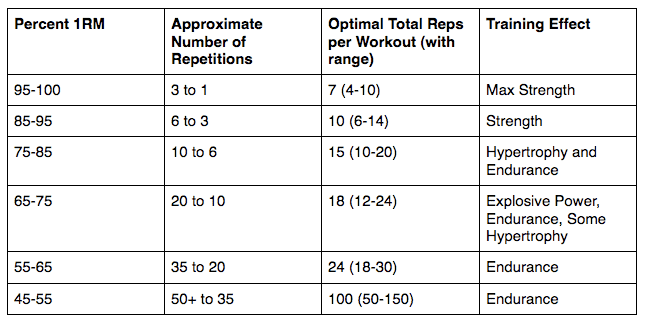
Our base level of strength is build on accelerated adaptation through the overloading principle and the arousal of coordination through the eustress of the Central Nervous System. The rep ranges used in our linear progression a.k.a the amateur program are meant to drive specific adaptation. The volume of the reps are set through the Prilepins Chart: https://powerathletehq.com/wp-content/uploads/2014/07/Prilepins-Chart.png where those reps represent a specific training effect (TE). To quote @cali on her Reverse Engineering With Prilepin’s Chart article:
“Reverse Engineering Theory:
1)I am training for A.
2)A requires B as a physiological adaptation.
3)To achieve B I need X number of reps at % intensity.
4)An effective training day will require around Z repetitions.
5)Therefore, I will complete Y setx of X repetitions to achieve Z.”
The rep ranges in this case will be constant and consistent(volume) the intensity will be provided by the overloading principle of incrementally adding more weight each time a lift repeats hence driving adaptation. When we are working with a novice athlete and they are in the middle of their linear progression program there will be a point where the intensity will be to high and the reps will drop. Like Luke Summers said in the PA1 Video presentation: “load sets the reps” when we encounter this issue of an novice athlete not fulfilling the rep range requirement because of intensity we back off for 3 weeks and allow the athlete to work on less stress while hitting the correct rep range and now allowing him to work on the concentric movement of the lift by applying force and explosion.
Siff(supertraining) talks about how volume and intensity are used as the most general characteristics of the training load as the training load is related to muscular work which the body must produce to carry a given regime of exercise in training for competition. In our case we use a constant Volume and a consistent increase of Intensity to drive a specific adaptation to an imposed demand. -
March 28, 2016 at 7:35 am #713
BlOS starts of as the Repetitive Effort Method where it, “consists of repetitively lifting a weight whose magnitude is increased as muscular strength grows” (Siff pg.258). With this gradual increase in load overtime we are able to drive adaptations of the central nervous system, as well as increased hypertrophy. This brings the athlete closer and closer to true RMs where they can drive these adaptations. Once we approach these true RMs the athlete is then able to take advantage of the brief maximal tension method, “lifting maximal and near maximal weights chances the ability to accelerate heavy loads and increases the special work capacity, as expressed by the skill to develop a brief concentrated effort of great power”(Siff pg.260). This gradual increase in intensity is what allows to work on these specific attributes. Siff later on states “the intensity go the loading determines the strength and specificity of its effect on the body or the difficulty of the training.” Volume translates into increased work capacity “The function of the volume of the load insist chiefly of the systematic and prolonged disturbance of the body’s homeostasis, which stimulates the mobilization of its energy resources and plastic reserves” We can not look at these two as independent variables. They greatly influence each other “the influence of volume can be detrained correctly only if one takes into consideration the magnitude of the loading, duration and activity”(Siff pg.258). All of these are being raised through out the amateur progression. This linear increase on the body will eventually start to slow because of the bodies ability to adapt. “In general, during periods of strenuous training, athletes cannot achieve the best performance results for two main reasons. First, it takes time to adapt to the training stimulus. Second, hard training work induces fatigue that accumulates over time” (Zatsiorsky pg.98). When this happens a period of “easy” exercise is needed to allow the athlete adapt the volume and intensity, we do this through our resets. Zatsiorsky calls this the period of delayed transformation
-
March 28, 2016 at 7:51 am #714
Our intensity levels in the BLoS development start with the Submaximal Effort Method. Zatsiorsky states, the Maximal Effort Method has limitations to beginners because of high risk of injury from lack of technique and lack of neuromuscular coordination (1995, p.81). Our use of the Submaximal Effort Method allows the athlete to develop the needed neuromuscular coordination and technical proficiency that will be needed once the weight gets heavy and the athlete begins to reach his rep max. The volume of our BLoS program is steady throughout each weak until the athlete begins to fail. When the athlete fails, volume self-adjusts based on the volume. Remember when Luke said “load must dictate reps”? This is what we are talking about for this program; the intensity (load) must dictate volume (reps) to drive the specific adaptation we are training for (The Amateur Program, 2016, Time hack 10:48).
I mentioned when an athlete fails earlier, now we will talk about the failure and reset. The program will self-regulate when failure occurs. We’ll see the athlete start to fail in the 1-3 rep range down the road in the program. This allows the athlete to get the majority of adaptation through the CNS rep range and well back off the weight to 3 weeks back. Intensity drops and volumes rises. This allows use to work on the athletes general speed and continue to get more and more reps under the bar to train towards the athlete’s unconscious-competence (automatic motor response) (Siff, 2004, p.24).
The volume and intensity in the BLoS program works like the ebb and flow of the tide in the ocean. At the beginning we have a constant flow inward (intensity increasing). The flow cannot go forever and will start to ebb back. This is indicative of our reset. We push the intensity until we can’t go any more and well reset (ebb) the athlete and they will flow back up the shore even more past the last weight they successfully completed. This is the proof of further adaptation for the athlete. This ebb and flow is the art and science the coach needs to manage through the program to accelerate the adaptation of establishing the BLoS.
-
March 28, 2016 at 8:53 am #717
Volume and intensity: the most important balancing act when discussing training, especially the novice athlete. The PA Amateur progression initially addresses this relationship through the repetitive effort method which, “is appropriate in the initial stages of strength development and when strength and it’s speed production are not necessary” (Siff, 259). This is the antithesis of the novice athlete – where speed is not the primary concern but building strength is. “The training effect is enhanced by increasing the magnitude of the load and the volume of the work” (Siff, 259). The enhancement is achieved via the linear progression of weight and the volume of work is accumulated over multiple months ie opportunity. As one progresses through the program there is a natural shift to brief maximal tension method which ups the intensity but limits the volume. “The strength training effect is enhanced by increasing the maximal weight, increasing the average weight lifted per session and reducing the number of sets and repetions” (Siff, 259). The PAAP’s beauty lies in it self regulating features. The balancing of volume and intensity is inherent in the structure of linear progression and ample opportunity.
But as we all know the tree can’t grow to the sky so to allow for continued adaptation ie gainzzz resets allow for the brief reduction in intensity to allow for actualization of adaptations and to begin to develop speed. “A period of relatively easy exercise is needed to realize the effect of the previous hard training sessions” (Zatsiorsky, 98). As you reveal the delayed training effects you simultaneously begin to work speed and rate of force development. This is the next step in the evolution of the novice athlete. The ability to not only produce force but to do so quickly is now possible because of the inter- and intramuscular coordination you have been developing all along. As you continue on the road the concerted development of coordination, hypertrophy, and speed will set the stage for a Base Level of
Strength courtesy of volume and intensity done just right. -
AuthorPosts


You must be logged in to reply to this topic.